 |
WarpTwin
Documentation for WarpTwin models and classes.
|
|
WarpTwin
Documentation for WarpTwin models and classes.
|
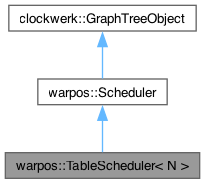
Simple, table-based scheduler for flight software. More...
#include <TableScheduler.hpp>
Public Member Functions | |
| TableScheduler (OS &os) | |
| Constructor for the scheduler. | |
| ~TableScheduler () | |
| virtual int16 | startup () override |
| Start the table scheduler. | |
| virtual int16 | step (const clockwerk::Time &step_val) override |
| Function to execute a single table schedule slot. | |
| virtual int16 | run () override |
| Function to run the scheduler until pre-determined end conditions identified/calculated by the scheduler. | |
| virtual int16 | registerApp (App &app, int16 slot) override |
| Register an app with the table scheduler. | |
| virtual int16 | unregisterApp (int16 slot) override |
| Function to unregister a certain schedule slot. | |
| uint8 | taskFailures () |
| Get number of task failures. | |
| uint16 | currentSlot () |
| Get the current schedule slot (executed previous step). | |
| uint8 | scheduleExceedances () |
| Get the number of schedule exceedances. | |
| const tlm_executive_schedule_overrun & | lastExceedance () |
| Return the last task to exceed its slot. | |
| const tlm_executive_app_error & | lastTaskFailure () |
| Get handle to record of last failure. | |
| const clockwerk::Time & | timePerSlot () |
| Get the time per slot. | |
| const App * | lastAppRun () |
| Get handle to the last app run. | |
| Public Member Functions inherited from warpos::Scheduler | |
| Scheduler () | |
| Constructor for the scheduler. | |
| void | terminate () |
| Terminate the scheduler. | |
| bool | isTerminated () |
| Get whether scheduler is terminated. | |
| void | setExecutive (FlightExecutive *exc) |
| Set the flight executive for the scheduler. | |
| Public Member Functions inherited from clockwerk::GraphTreeObject | |
| GraphTreeObject (const char *gt_nme="", GraphTreeObject **storage_array=nullptr, uint32 storage_size=0) | |
| Name-based constructor for GraphTreeObject which will have no children by default. | |
| virtual | ~GraphTreeObject () |
| Destructor. | |
| GraphTreeObject * | parent () |
| Functions to get object's parent/children. | |
| GraphTreeObject ** | children () |
| GraphTreeObject * | childAtIndex (uint8 i) const |
| int16 | parent (GraphTreeObject *new_parent) |
| Function to assign the node's parent via pointer. | |
| int16 | parent (GraphTreeObject &new_parent) |
| Function to assign the node's parent via reference. | |
| uint8 | nChildren () const |
| Getters for number of children and descendants. | |
| uint16 | nDescendants () const |
| uint8 | capacity () const |
| const char * | name () const |
| Getter and setter for object name. | |
| int16 | name (const char *new_name) |
| uint8 | rank () |
| Getter for the object rank. | |
| int8 | type () |
| Function to indicate type – -1 by default unless implemented downstream. | |
| bool | loggable () |
| Getter for object logability flag – note no setter because should only be set by this or a derived class in its definition. | |
| GraphTreeObject * | getRootDataPointer () |
| Get the pointer to the highest object in the graph tree. | |
| virtual int16 | str (char *output, size_t size) const |
| Get object represented as string. | |
| virtual int16 | fromStr (const char *val) |
| Set value of graphtreeobject from string. | |
Protected Member Functions | |
| uint16 | _getNextSlot (uint16 current_slot) |
| Return schedule slot after current one. | |
| Protected Member Functions inherited from clockwerk::GraphTreeObject | |
| int16 | _setStorage (GraphTreeObject **storage_array, uint8 storage_size) |
| Getter for object's string address. | |
| void | _recalculateDescendants () |
| Function to recursively re-calculate the number of descendants of a given node on the tree. | |
| void | _recalculateRank () |
| Function to recursively re-calculate the rank of a given node on the tree. | |
| int16 | _addChild (GraphTreeObject *child) |
| Function to decompose a string into a series of substrings via indexing. | |
| int16 | _removeChild (GraphTreeObject *child) |
| Function to remove a child from the graph node's children. | |
Protected Attributes | |
| OS & | _os |
| Handle to the os from which we pull system time. | |
| App * | _schedule_array [N] |
| Array to hold the actual schedule slot. | |
| bool | _scheduler_initialized = false |
| Flag indicating whether time has been initialized. | |
| int16 | _current_slot = 0 |
| The current schedule slot to execute. | |
| int16 | _end_slot = 0 |
| The slot where schedule run ended. | |
| uint32 | _nsec_per_slot = clockwerk::NSEC_PER_SEC_I/N |
| The number of nsec allocated per slot. | |
| clockwerk::Time | _step_size |
| The step size as a clockwerk time. | |
| int16 | _error = 0 |
| Variable to catch errors out of runs. | |
| char | _print_buf [200] |
| tlm_executive_app_error | _tlm_error |
| tlm_executive_schedule_overrun | _tlm_overrun |
| Protected Attributes inherited from warpos::Scheduler | |
| bool | _is_terminated = false |
| Flag to indicate whether the scheduler is terminated. | |
| FlightExecutive * | _exc_ptr |
| Pointer to the executive which may optionally be registered with scheduler. | |
| Protected Attributes inherited from clockwerk::GraphTreeObject | |
| GraphTreeObject * | _parent = nullptr |
| GraphTreeObject ** | _children_ptr = nullptr |
| uint32 | _max_num_children = 0 |
| uint16 | _num_descendants = 0 |
| char | _name [MAXIMUM_NAME_CHARS] = "" |
| String name for object. | |
| uint8 | _num_children = 0 |
| Number of direct children of the tree (not including the tree itself). | |
| uint8 | _rank = 0 |
| int8 | _graph_tree_type = BASE_GRAPH_TREE |
| Variable to store graph tree object type. | |
| bool | _loggable = false |
| Variable to indicate whether the selected object is loggable. Set to false by default. | |
| uint32 | _index = 0 |
| Index pointing to the next write location for the graph tree children. | |
Simple, table-based scheduler for flight software.
The TableScheduler is an ultra simple, table-based scheduler instance for running tasks in soft real time on embedded systems. It is templated to have N schedule slots, which are distributed among steps of 1 second.
To add a task to the schedule, call scheduleTask with the task or app and the desired schedule slot. By default tasks are scheduled to take exactly one slot. However, a task may be programmed to take more than one schedule slot by programming it sequentially (in back to back slots).
The TableScheduler is fixed to full second boundaries in the system time, and will return warning until it is allowed to start on a full second boundary. Afterwards, timing is based on the partial seconds in the full second.
Inside of TableScheduler run, the scheduler is designed to call os yield between steps to allow lower priority tasks outside the table scheduler to run.
| warpos::TableScheduler< N >::TableScheduler | ( | OS & | os | ) |
Constructor for the scheduler.
| os | Reference to the OS object |
|
inline |
|
protected |
Return schedule slot after current one.
| current_slot | The current slot |
|
inline |
Get the current schedule slot (executed previous step).
|
inline |
Get handle to the last app run.
|
inline |
Return the last task to exceed its slot.
|
inline |
Get handle to record of last failure.
|
overridevirtual |
Register an app with the table scheduler.
| app | The app to register |
| schedule_slot | The slot to register the app to |
Reimplemented from warpos::Scheduler.
|
overridevirtual |
Function to run the scheduler until pre-determined end conditions identified/calculated by the scheduler.
Reimplemented from warpos::Scheduler.
|
inline |
Get the number of schedule exceedances.
|
overridevirtual |
Start the table scheduler.
Reimplemented from warpos::Scheduler.
|
overridevirtual |
Function to execute a single table schedule slot.
| ref_time | The current time, which is used to determine the slot which runs |
Reimplemented from warpos::Scheduler.
|
inline |
Get number of task failures.
|
inline |
Get the time per slot.
|
overridevirtual |
Function to unregister a certain schedule slot.
| slot | Slot to unregister |
Reimplemented from warpos::Scheduler.
|
protected |
The current schedule slot to execute.
|
protected |
The slot where schedule run ended.
|
protected |
Variable to catch errors out of runs.
|
protected |
The number of nsec allocated per slot.
|
protected |
Handle to the os from which we pull system time.
|
protected |
|
protected |
Array to hold the actual schedule slot.
|
protected |
Flag indicating whether time has been initialized.
|
protected |
The step size as a clockwerk time.
|
protected |
|
protected |
 1.16.1