 |
WarpTwin
Documentation for WarpTwin models and classes.
|
|
WarpTwin
Documentation for WarpTwin models and classes.
|
#include <GPSUpdate.h>
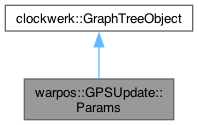
Public Member Functions | |
| Params (clockwerk::GraphTreeObject *par, const char *nme) | |
| Public Member Functions inherited from clockwerk::GraphTreeObject | |
| GraphTreeObject (const char *gt_nme="", GraphTreeObject **storage_array=nullptr, uint32 storage_size=0) | |
| Name-based constructor for GraphTreeObject which will have no children by default. | |
| virtual | ~GraphTreeObject () |
| Destructor. | |
| GraphTreeObject * | parent () |
| Functions to get object's parent/children. | |
| GraphTreeObject ** | children () |
| GraphTreeObject * | childAtIndex (uint8 i) const |
| int16 | parent (GraphTreeObject *new_parent) |
| Function to assign the node's parent via pointer. | |
| int16 | parent (GraphTreeObject &new_parent) |
| Function to assign the node's parent via reference. | |
| uint8 | nChildren () const |
| Getters for number of children and descendants. | |
| uint16 | nDescendants () const |
| uint8 | capacity () const |
| const char * | name () const |
| Getter and setter for object name. | |
| int16 | name (const char *new_name) |
| uint8 | rank () |
| Getter for the object rank. | |
| int8 | type () |
| Function to indicate type – -1 by default unless implemented downstream. | |
| bool | loggable () |
| Getter for object logability flag – note no setter because should only be set by this or a derived class in its definition. | |
| GraphTreeObject * | getRootDataPointer () |
| Get the pointer to the highest object in the graph tree. | |
| virtual int16 | str (char *output, size_t size) const |
| Get object represented as string. | |
| virtual int16 | fromStr (const char *val) |
| Set value of graphtreeobject from string. | |
Public Attributes | |
| clockwerk::DataIO< clockwerk::Time > | time_diff_stale_bound = clockwerk::DataIO<clockwerk::Time>(this, "time_diff_stale_bound", clockwerk::Time(1, 0)) |
| clockwerk::DataIO< clockwerk::CartesianVector< 3 > > | GPS_meas_noise = clockwerk::DataIO<clockwerk::CartesianVector<3>>(this, "GPS_meas_noise", clockwerk::CartesianVector<3>({0.0, 0.0, 0.0})) |
| clockwerk::DataIO< clockwerk::CartesianVector< 3 > > | pos_pI_tI__pI = clockwerk::DataIO<clockwerk::CartesianVector<3>>(this, "pos_pI_tI__pI", clockwerk::CartesianVector<3>({0.0, 0.0, 0.0})) |
| clockwerk::DataIO< clockwerk::CartesianVector< 3 > > | pos_GPS_B__B = clockwerk::DataIO<clockwerk::CartesianVector<3>>(this, "pos_GPS_B__B", clockwerk::CartesianVector<3>({0.0, 0.0, 0.0})) |
Additional Inherited Members | |
| Protected Member Functions inherited from clockwerk::GraphTreeObject | |
| int16 | _setStorage (GraphTreeObject **storage_array, uint8 storage_size) |
| Getter for object's string address. | |
| void | _recalculateDescendants () |
| Function to recursively re-calculate the number of descendants of a given node on the tree. | |
| void | _recalculateRank () |
| Function to recursively re-calculate the rank of a given node on the tree. | |
| int16 | _addChild (GraphTreeObject *child) |
| Function to decompose a string into a series of substrings via indexing. | |
| int16 | _removeChild (GraphTreeObject *child) |
| Function to remove a child from the graph node's children. | |
| Protected Attributes inherited from clockwerk::GraphTreeObject | |
| GraphTreeObject * | _parent = nullptr |
| GraphTreeObject ** | _children_ptr = nullptr |
| uint32 | _max_num_children = 0 |
| uint16 | _num_descendants = 0 |
| char | _name [MAXIMUM_NAME_CHARS] = "" |
| String name for object. | |
| uint8 | _num_children = 0 |
| Number of direct children of the tree (not including the tree itself). | |
| uint8 | _rank = 0 |
| int8 | _graph_tree_type = BASE_GRAPH_TREE |
| Variable to store graph tree object type. | |
| bool | _loggable = false |
| Variable to indicate whether the selected object is loggable. Set to false by default. | |
| uint32 | _index = 0 |
| Index pointing to the next write location for the graph tree children. | |
|
inline |
| clockwerk::DataIO<clockwerk::CartesianVector<3> > warpos::GPSUpdate::Params::GPS_meas_noise = clockwerk::DataIO<clockwerk::CartesianVector<3>>(this, "GPS_meas_noise", clockwerk::CartesianVector<3>({0.0, 0.0, 0.0})) |
The GPS measurement noise standard deviation. See the position component definition in (inputs/outputs) to understand the frame of reference and relative state. The process noise standard deviation is set on system start-up, but can be changed via a command during any part of operation. (meters)
| clockwerk::DataIO<clockwerk::CartesianVector<3> > warpos::GPSUpdate::Params::pos_GPS_B__B = clockwerk::DataIO<clockwerk::CartesianVector<3>>(this, "pos_GPS_B__B", clockwerk::CartesianVector<3>({0.0, 0.0, 0.0})) |
The position of the GPS receiver with resepct to the body (B) frame resolved in body frame coordinates. Defaults to zero which is a decent approximation for small vehicles but is not a negligible value. (meters)
| clockwerk::DataIO<clockwerk::CartesianVector<3> > warpos::GPSUpdate::Params::pos_pI_tI__pI = clockwerk::DataIO<clockwerk::CartesianVector<3>>(this, "pos_pI_tI__pI", clockwerk::CartesianVector<3>({0.0, 0.0, 0.0})) |
The position of the pseudo-inertial (pI) frame with respect to the true inertial (tI) frame as provided in pseudo-inertial (pI) frame coordinates. Defaults to zero because this is the usual case, e.g. using ECEF or ECI. The true inertial frame origin is defined to be where the primary bodies gravitational potential singularity exists. (meters)
| clockwerk::DataIO<clockwerk::Time> warpos::GPSUpdate::Params::time_diff_stale_bound = clockwerk::DataIO<clockwerk::Time>(this, "time_diff_stale_bound", clockwerk::Time(1, 0)) |
The maximum time difference that is allowed between the input state time stamp (t_{k}) and the measurement time stamp. The EKF will not incorporate a measurement that is too stale. Defaults to 5 (seconds).
 1.16.1