 |
WarpTwin
Documentation for WarpTwin models and classes.
|
|
WarpTwin
Documentation for WarpTwin models and classes.
|
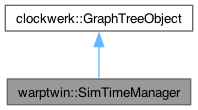
Class to manage time for the simulation object. More...
#include <SimTimeManager.h>
Public Member Functions | |
| SimTimeManager () | |
| Base constructor – time manager should initialize to zeros and then be set. | |
| virtual | ~SimTimeManager () |
| void | stepTime (const clockwerk::Time &step) |
| Function to increment all times. | |
| void | updateStep (const clockwerk::Time &step) |
| Function to increment step start and end time. | |
| clockwerk::Time | wallClockTimer () |
| Function to return the wall clock time since run start. | |
| double | str2tdb (const std::string &time_input) |
| std::string | tdbTime () |
| Function to return the TDB time as a string. | |
| std::string | utcTime () |
| Function to return the TDB time as a string. | |
| std::string | jdTime () |
| Function to return the Julian date as a string. | |
| std::string | gpsTime () |
| Function to return the GPS time as a string. | |
| double | decimalYear () |
| Function to return the decimal year as a double. | |
| int | configureSystemTime (const clockwerk::Time &offset, uint32 resolution_nsec=1) |
| Configure the os.systemTime() and system_time outputs. | |
| void | configureNavigationTime (const std::string &source="SYSTEM") |
| Configure the os.navigationTime() and navigation_time outputs. | |
| void | setTime (const std::string &time_input=DEFAULT_SIMULATION_TIME) |
| Function to set time by string input. | |
| bool | wallClockIsStarted () |
| Function to return whether the wall clock timer is started. | |
| void | setTime (clockwerk::Time set_val) |
| Set time to val set_val (to something different than sim time manager). | |
| void | unsetTime () |
| Set time to unset system time (return to SimTimeManager value). | |
| Public Member Functions inherited from clockwerk::GraphTreeObject | |
| GraphTreeObject (const char *gt_nme="", GraphTreeObject **storage_array=nullptr, uint32 storage_size=0) | |
| Name-based constructor for GraphTreeObject which will have no children by default. | |
| virtual | ~GraphTreeObject () |
| Destructor. | |
| GraphTreeObject * | parent () |
| Functions to get object's parent/children. | |
| GraphTreeObject ** | children () |
| GraphTreeObject * | childAtIndex (uint8 i) const |
| int16 | parent (GraphTreeObject *new_parent) |
| Function to assign the node's parent via pointer. | |
| int16 | parent (GraphTreeObject &new_parent) |
| Function to assign the node's parent via reference. | |
| uint8 | nChildren () const |
| Getters for number of children and descendants. | |
| uint16 | nDescendants () const |
| uint8 | capacity () const |
| const char * | name () const |
| Getter and setter for object name. | |
| int16 | name (const char *new_name) |
| uint8 | rank () |
| Getter for the object rank. | |
| int8 | type () |
| Function to indicate type – -1 by default unless implemented downstream. | |
| bool | loggable () |
| Getter for object logability flag – note no setter because should only be set by this or a derived class in its definition. | |
| GraphTreeObject * | getRootDataPointer () |
| Get the pointer to the highest object in the graph tree. | |
| virtual int16 | str (char *output, size_t size) const |
| Get object represented as string. | |
| virtual int16 | fromStr (const char *val) |
| Set value of graphtreeobject from string. | |
Public Attributes | |
| clockwerk::DataIO< clockwerk::Time > | step_start_time = clockwerk::DataIO<clockwerk::Time>(this, "step_start_time") |
| clockwerk::DataIO< clockwerk::Time > | step_end_time = clockwerk::DataIO<clockwerk::Time>(this, "step_end_time") |
| This is the time at the end of a given scheduler step. | |
| clockwerk::DataIO< clockwerk::Time > | base_time = clockwerk::DataIO<clockwerk::Time>(this, "base_time") |
| This is the exact current time as the scheduler steps forward. | |
| clockwerk::DataIO< clockwerk::Time > | tdb_time = clockwerk::DataIO<clockwerk::Time>(this, "tdb_time") |
| clockwerk::DataIO< clockwerk::Time > | gps_time = clockwerk::DataIO<clockwerk::Time>(this, "gps_time") |
| clockwerk::DataIO< clockwerk::Time > | utc_time = clockwerk::DataIO<clockwerk::Time>(this, "utc_time") |
| clockwerk::DataIO< clockwerk::Time > | system_time = clockwerk::DataIO<clockwerk::Time>(this, "system_time") |
| clockwerk::DataIO< clockwerk::Time > | navigation_time = clockwerk::DataIO<clockwerk::Time>(this, "navigation_time") |
Protected Attributes | |
| clockwerk::Time | _diff |
| struct timespec | _tmp |
| clockwerk::Time * | _start_step_ptr |
| Pointers to our time objects. | |
| clockwerk::Time * | _end_step_ptr |
| clockwerk::Time * | _base_time_ptr |
| clockwerk::Time * | _tdb_time_ptr |
| clockwerk::Time * | _gps_time_ptr |
| clockwerk::Time * | _utc_time_ptr |
| clockwerk::Time * | _system_time_ptr |
| bool | _started = false |
| clockwerk::Time | _start |
| clockwerk::Time | _now |
| clockwerk::Time | _system_time_offset = clockwerk::Time(0, 0) |
| uint32 | _system_time_resolution = 1 |
| nav_time_sources_e | _nav_time_source = nav_time_sources_e::NAV_SRC_SYSTEM |
| clockwerk::Time | _nav_base_time |
| bool | _sys_time_set = false |
| GraphTreeObject * | _children [MAXIMUM_APP_CHILDREN] |
| Protected Attributes inherited from clockwerk::GraphTreeObject | |
| GraphTreeObject * | _parent = nullptr |
| GraphTreeObject ** | _children_ptr = nullptr |
| uint32 | _max_num_children = 0 |
| uint16 | _num_descendants = 0 |
| char | _name [MAXIMUM_NAME_CHARS] = "" |
| String name for object. | |
| uint8 | _num_children = 0 |
| Number of direct children of the tree (not including the tree itself). | |
| uint8 | _rank = 0 |
| int8 | _graph_tree_type = BASE_GRAPH_TREE |
| Variable to store graph tree object type. | |
| bool | _loggable = false |
| Variable to indicate whether the selected object is loggable. Set to false by default. | |
| uint32 | _index = 0 |
| Index pointing to the next write location for the graph tree children. | |
Additional Inherited Members | |
| Protected Member Functions inherited from clockwerk::GraphTreeObject | |
| int16 | _setStorage (GraphTreeObject **storage_array, uint8 storage_size) |
| Getter for object's string address. | |
| void | _recalculateDescendants () |
| Function to recursively re-calculate the number of descendants of a given node on the tree. | |
| void | _recalculateRank () |
| Function to recursively re-calculate the rank of a given node on the tree. | |
| int16 | _addChild (GraphTreeObject *child) |
| Function to decompose a string into a series of substrings via indexing. | |
| int16 | _removeChild (GraphTreeObject *child) |
| Function to remove a child from the graph node's children. | |
Class to manage time for the simulation object.
This class uses the SPICE module to manage time within the simulation. Internally it steps the sim time and the spice ephemeris time (TDB time), which is used to cast UTC and JD time scales. All are published on the time manager.
The SimTimeManager publishes 4 different types of time:
Time representations are based on the clockwerk Time class.
| warptwin::SimTimeManager::SimTimeManager | ( | ) |
Base constructor – time manager should initialize to zeros and then be set.
|
inlinevirtual |
| void warptwin::SimTimeManager::configureNavigationTime | ( | const std::string & | source = "SYSTEM" | ) |
Configure the os.navigationTime() and navigation_time outputs.
| source | The source navigation time is connected to. Valid choices are: SYSTEM, GPS, UTC, TDB |
| int warptwin::SimTimeManager::configureSystemTime | ( | const clockwerk::Time & | offset, |
| uint32 | resolution_nsec = 1 ) |
Configure the os.systemTime() and system_time outputs.
Methods to set time The following functions allow users to set time based on string
| offset | The offset between simulation time and system time. Must be positive |
| resolution | The resolution of time output, in nanoseconds. Default is full resolution. |
| double warptwin::SimTimeManager::decimalYear | ( | ) |
Function to return the decimal year as a double.
| std::string warptwin::SimTimeManager::gpsTime | ( | ) |
Function to return the GPS time as a string.
| std::string warptwin::SimTimeManager::jdTime | ( | ) |
Function to return the Julian date as a string.
|
inline |
Set time to val set_val (to something different than sim time manager).
| set_val | The time to set |
| void warptwin::SimTimeManager::setTime | ( | const std::string & | time_input = DEFAULT_SIMULATION_TIME | ) |
Function to set time by string input.
| time_input | The string input by which time will be set. valid inputs are any input which is accepted by the SPICE function STR2ET. More info here: https://naif.jpl.nasa.gov/pub/naif/toolkit_docs/FORTRAN/spicelib/str2et.html This value defaults to 2023 September 26, 12:00:00 MDT |
| void warptwin::SimTimeManager::stepTime | ( | const clockwerk::Time & | step | ) |
Function to increment all times.
| step | Time object to step by |
| double warptwin::SimTimeManager::str2tdb | ( | const std::string & | time_input | ) |
|
inline |
|
inline |
Set time to unset system time (return to SimTimeManager value).
| void warptwin::SimTimeManager::updateStep | ( | const clockwerk::Time & | step | ) |
Function to increment step start and end time.
| step | Time object to step by |
| std::string warptwin::SimTimeManager::utcTime | ( | ) |
Function to return the TDB time as a string.
|
inline |
Function to return whether the wall clock timer is started.
| clockwerk::Time warptwin::SimTimeManager::wallClockTimer | ( | ) |
|
protected |
|
protected |
|
protected |
|
protected |
|
protected |
|
protected |
|
protected |
|
protected |
|
protected |
|
protected |
Pointers to our time objects.
|
protected |
|
protected |
|
protected |
|
protected |
|
protected |
|
protected |
|
protected |
|
protected |
| clockwerk::DataIO<clockwerk::Time> warptwin::SimTimeManager::base_time = clockwerk::DataIO<clockwerk::Time>(this, "base_time") |
This is the exact current time as the scheduler steps forward.
| clockwerk::DataIO<clockwerk::Time> warptwin::SimTimeManager::gps_time = clockwerk::DataIO<clockwerk::Time>(this, "gps_time") |
GPS Time represented as seconds relative to the GPS epoch of January 6, 1980.
| clockwerk::DataIO<clockwerk::Time> warptwin::SimTimeManager::navigation_time = clockwerk::DataIO<clockwerk::Time>(this, "navigation_time") |
Output for the os.navigationTime() call used by flight software functions and sensor models. Configured based on configureSystemTime call for this class
| clockwerk::DataIO<clockwerk::Time> warptwin::SimTimeManager::step_end_time = clockwerk::DataIO<clockwerk::Time>(this, "step_end_time") |
This is the time at the end of a given scheduler step.
| clockwerk::DataIO<clockwerk::Time> warptwin::SimTimeManager::step_start_time = clockwerk::DataIO<clockwerk::Time>(this, "step_start_time") |
| clockwerk::DataIO<clockwerk::Time> warptwin::SimTimeManager::system_time = clockwerk::DataIO<clockwerk::Time>(this, "system_time") |
Output for the os.systemTime() call used by flight software functions. Configured based on configureSystemTime call for this class
| clockwerk::DataIO<clockwerk::Time> warptwin::SimTimeManager::tdb_time = clockwerk::DataIO<clockwerk::Time>(this, "tdb_time") |
TDB time is represented as seconds relative to the J2000 epoch, which is January 1, 2000, at 12:00 TT (Terrestrial Time). This is also known as "ephemeris time"
| clockwerk::DataIO<clockwerk::Time> warptwin::SimTimeManager::utc_time = clockwerk::DataIO<clockwerk::Time>(this, "utc_time") |
UTC Time represented as seconds relative to the J2000 epoch of January 1, 2000.
 1.16.1