|
| virtual int16 | calculateDynamics (floating_point time, const std::array< floating_point, N > &tar_state, const std::array< floating_point, O > &obs_state, std::array< floating_point, N > &tar_state_dot) |
| | Function to calculate a state time derivative from current state of system.
|
| virtual int16 | calculateDynamicsJacobian (floating_point time, const std::array< floating_point, N > &tar_state, const std::array< floating_point, O > &obs_state, std::array< floating_point, N *N > &dynamics_Jacobian) |
| | Function to calculate the dynamics function Jacobian from current state of system.
|
| virtual int16 | calculateDynamicsNoiseMappingMatrix (floating_point time, const std::array< floating_point, N > &tar_state, const std::array< floating_point, O > &obs_state, std::array< floating_point, N *D > &dynamics_mapping) |
| | Function to calculate the matrix that maps the noise configuration space to the state configuration space.
|
| virtual int16 | calculateNoiseCovariance (floating_point time, const std::array< floating_point, N > &tar_state, const std::array< floating_point, O > &obs_state, std::array< floating_point, D *D > &process_covariance) |
| | Function to calculate the covariance matrix of a given process with a specific noise profile.
|
| virtual int16 | calculateObserverDynamics (floating_point time, const std::array< floating_point, N > &tar_state, const std::array< floating_point, O > &obs_state, std::array< floating_point, O > &obs_state_dot) |
| | Function to calculate the observer state vector time vector.
|
| int16 | calculateRates (floating_point time, const std::array< floating_point, N+N *N+O > &state, std::array< floating_point, N+N *N+O > &out_rates) override |
| | Function to calculate rates from current state of system.
|
| virtual int16 | calculateRates (floating_point time, const std::array< floating_point, N > &state, std::array< floating_point, N > &out_rates) |
| | Function to calculate rates from current state of system.
|
template<uint32 N, uint32 O, uint32 D>
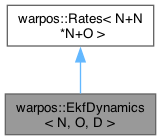
class warpos::EkfDynamics< N, O, D >
The dynamics class defines a generic, templated base class which may be used generically as a time update in the EKF time update class. The values N, O, and D should be assigned and are defined as follows: N - The number of states in the target state vector. i.e. 3 for [x, y, z] O - The number of observer states. May be unused but could be i.e. another [x, y, z] for range D - The number of noise states. Typically the same as N but could be i.e. state is [range, rangerate] but noise is modeled as [x, y, z] variances
This class should be inherited from for each state dynamics used on a system
Author: James Tabony james.nosp@m..tab.nosp@m.ony@a.nosp@m.ttx..nosp@m.tech

 1.16.1